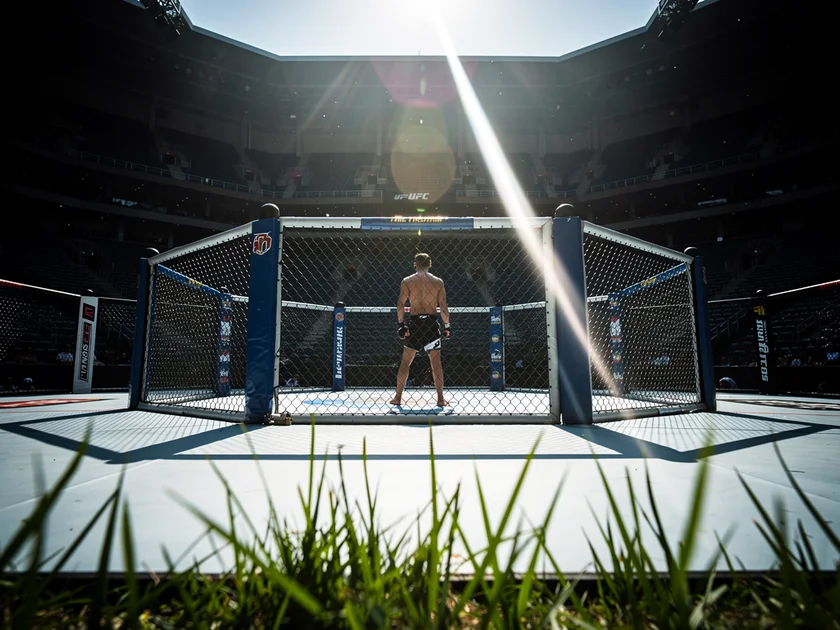
Brock Lesnar disclosed on March 26, 2026, that UFC CEO Dana White “wanted nothing to do with me” when Lesnar first sought entry into the UFC Heavyweight Division. That admission reframes one of the most improbable championship runs in divisional history — a former WWE performer who absorbed an early loss, rebuilt his record, then claimed the heavyweight title.
Lesnar’s candid account, published by MMA Fighting, strips away the mythology around his UFC arrival. What replaces it is a far more ordinary story: a phone that went unanswered and a promoter who needed convincing.
How Lesnar Broke Into the UFC Heavyweight Division
Lesnar’s path into the UFC began with a single-fight agreement after White finally relented — not a marquee signing. White gave him one shot. Lesnar promptly lost it, dropping a submission defeat to Frank Mir in his promotional debut. That result would have ended most careers before they started.
Instead, Lesnar returned and dismantled PRIDE veteran Heath Herring by decision. That performance demonstrated his wrestling base could suppress experienced strikers and grapplers alike. His NCAA Division I credentials translated directly into octagon control and takedown success, neutralizing opponents before they could establish range or threaten submissions from guard.
The Herring win opened the door to Randy Couture. Lesnar defeated the decorated champion to claim the UFC heavyweight title. That ascent — from one-shot prospect to belt-holder — compressed years of typical contender development into fewer than three fights. Lesnar stood 6-foot-3 and weighed an estimated 265-plus pounds. That size differential gave him a reach and weight advantage that Couture, fighting near the upper limit of his natural frame, could not fully neutralize.
What Ended Lesnar’s Reign?
Lesnar’s heavyweight reign was ended by consecutive knockout losses. Those defeats drained whatever competitive drive had carried him through the earlier climb. A knockout loss in the heavyweight class carries particular weight — fighters in that division punch hard enough that a compromised chin, once exposed, is rarely trusted again against elite opposition.
Opponents discovered a recognizable pattern in Lesnar’s late UFC career. Pressing forward and landing power shots to the body and head disrupted his wrestling entries. Once takedown attempts were stuffed or his pace slowed, Lesnar lacked the technical striking to operate at distance. Two knockout defeats in succession confirmed the vulnerability was structural, not situational. He departed the UFC and returned to WWE.
That departure left the division without one of its most commercially valuable fighters. The broader heavyweight landscape at that time — featuring Cain Velasquez, Junior dos Santos, and an emerging Fabricio Werdum — continued to evolve rapidly. Lesnar’s absence felt sharp from a promotional standpoint, particularly given the pay-per-view numbers his fights had drawn.
Key Developments in Lesnar’s UFC Career
- White’s initial refusal forced Lesnar to pursue the deal through other channels before a single-fight arrangement was finally agreed upon.
- The Heath Herring win was secured by decision, not finish — showing Lesnar could sustain pace and octagon control across a full fight, not just overwhelm opponents in early exchanges.
- Lesnar’s title victory over Couture came with fewer professional MMA bouts than nearly any other fighter who had reached that level in the division’s history at that time.
- After two post-title knockout losses, Lesnar re-signed with WWE, closing what had been the division’s most commercially prominent chapter since the promotion’s early days.
- Lesnar’s UFC pay-per-view events consistently ranked among the promotion’s highest-selling cards during his active run, drawing audiences well beyond the sport’s core fanbase.
What Lesnar’s Story Means for Today’s Heavyweight Landscape
The UFC Heavyweight Division carries Lesnar’s legacy as a structural lesson about crossover athletes and the ceiling of raw physical tools without technical depth. His career arc — rapid rise, brief reign, swift decline — maps almost precisely onto what happens when elite wrestling credentials meet a division full of fighters who have spent years refining their striking and submission defense to counter grapplers. The lesson was absorbed quickly by coaches and matchmakers across the sport.
Jon Jones currently holds the UFC heavyweight title, with Tom Aspinall serving as interim champion and fighters like Ciryl Gane, Sergei Pavlovich, and Curtis Blaydes ranked among the division’s top contenders. That group operates with technical arsenals that dwarf what the 2008–2011 heavyweight landscape demanded of its participants. Lesnar’s run accelerated the conversation about what a complete heavyweight needed to look like — and the current top-10 reflects that evolution clearly.
One counterargument deserves acknowledgment. Lesnar’s reign, however brief, expanded the UFC‘s mainstream audience in ways that technically complete fighters rarely achieve. His WWE profile drew casual viewers who then stayed for the sport itself. Whether that trade-off benefits competitive credibility is a debate the UFC front office has never fully resolved — and probably never will.
Frequently Asked Questions
Why did Dana White initially refuse to sign Brock Lesnar?
White was skeptical of Lesnar’s MMA credentials given his background as a WWE performer with limited professional fighting experience. Lesnar had to pursue the deal persistently before White agreed to a one-fight trial arrangement rather than a standard multi-fight contract.
How many UFC fights did Lesnar have before winning the heavyweight title?
Lesnar won the UFC heavyweight title in his third promotional appearance, defeating Randy Couture. That number — three fights — was remarkably low for a title challenger by any historical standard in the division.
Who defeated Lesnar after his title reign ended?
Cain Velasquez stopped Lesnar via TKO in October 2010 to claim the heavyweight title. Alistair Overeem then knocked Lesnar out in December 2011, which proved to be Lesnar’s final UFC appearance before his return to WWE.
Did Lesnar ever return to the UFC after rejoining WWE?
Lesnar fought once more under the UFC banner at UFC 200 in July 2016, defeating Mark Hunt by unanimous decision. That result was later overturned to a no-contest after Lesnar failed a USADA drug test for clomiphene, a banned substance.