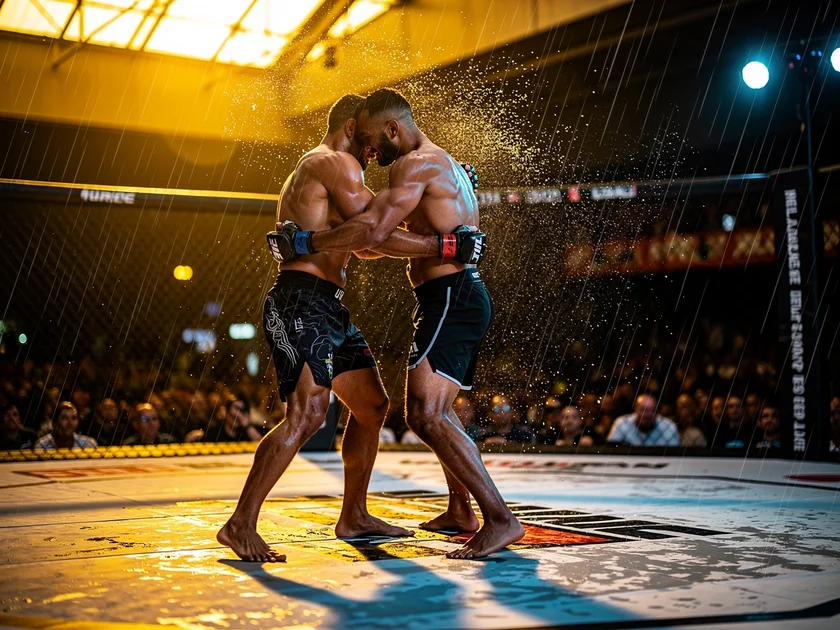
Israel Adesanya suffered a defeat against rising middleweight contender Joe Pyfer in the main event of a recent UFC card held in Seattle, a result that immediately forced a reassessment of where the former two-time champion goes from here. The loss — Adesanya’s second consecutive setback against a ranked contender — narrows his options at 185 pounds and opens a genuinely complicated conversation about the back half of his career.
Adesanya, who previously held the UFC middleweight title twice, had taken on Nassourdine Imavov before the Pyfer bout, continuing a pattern of fighting relevant, ranked opponents rather than stepping back to easier matchups. That competitive instinct is admirable. But the results have not followed.
Israel Adesanya’s Recent Struggles at Middleweight
Israel Adesanya‘s losses to Imavov and now Pyfer represent consecutive defeats against fighters younger and still ascending the divisional ladder. Pyfer, who entered the Seattle main event as a rising contender with serious knockout power, handed Adesanya a result that few in the hardcore fan base can easily dismiss as a fluke or an off night.
Breaking down the advanced metrics of Adesanya’s recent fights, a pattern emerges: his octagon control and fight IQ remain elite, but the chin and the cardio that carried him through his dominant title reign show more wear than they once did. Significant strike absorption has climbed in his recent bouts, and opponents are increasingly willing to pressure him in ways that middleweight contenders from 2019 to 2022 largely avoided. Pyfer, specifically, is the kind of compact pressure fighter who negates reach advantage and makes the weight cut feel even more punishing for a veteran frame.
The numbers suggest Adesanya still belongs in meaningful UFC fights. But “meaningful” and “title contention” are no longer the same sentence for a 36-year-old former champion navigating consecutive losses.
What Are the Best Opponent Options for Adesanya Now?
Based on available reporting, Anthony Hernandez stands out as the most logical next opponent if Adesanya stays at middleweight and continues targeting ranked contenders. Hernandez represents a competitive but not insurmountable test — the kind of fight that keeps Adesanya relevant in the divisional rankings without immediately throwing him back into a title eliminator.
Bleacher Report identified five potential opponents for Adesanya following the Pyfer defeat, with Hernandez among those cited for the middleweight route. Each option carries its own risk profile. A loss to Hernandez would drop Adesanya further down the rankings, while a win would re-establish him as a top-10 force worth tracking in the 185-pound weight class.
The film shows that Adesanya’s striking arsenal — the southpaw stance, the distance management, the front kick to the body — still generates problems for most middleweights. The question is whether those tools hold up against fighters who combine elite wrestling with heavy ground control time, a profile that describes several of the current top-five at 185.
Israel Adesanya and the Light Heavyweight Option
Israel Adesanya has fought at light heavyweight before, and according to Bleacher Report, a later-career move up to 205 pounds is a genuine possibility worth examining. Weight cuts become progressively harder as fighters age, and Adesanya is no exception to that physical reality.
The source specifically names Jamahal Hill as an appealing opponent should Adesanya elect to campaign at light heavyweight. Hill, a former 205-pound champion himself, would give the matchup genuine title-fight credibility on paper — two ex-champions, both with sharp striking and recognizable names, squaring off in a division where Adesanya would carry a natural size advantage over the middleweights he has been fighting.
Reinier de Ridder was also referenced in this context, with the source noting that de Ridder’s own potential shift toward light heavyweight stems from the same weight-cut fatigue that might push Adesanya up a class. Whether that alignment ever produces a matchup between the two remains speculative, but the logic of both men gravitating toward 205 is grounded in real physiological reasoning, not just promotional convenience.
A counterargument worth considering: Adesanya‘s entire striking game was built around the reach and movement advantages he carries at middleweight. Moving to light heavyweight means absorbing shots from bigger men, and his chin — already tested more frequently in recent bouts — would face heavier power shots from 205-pound opposition. The trade-off is not automatic.
Key Developments Following the Seattle Loss
- Adesanya fought Pyfer in the main event slot at the UFC’s Seattle event, confirming the promotion still views him as a marquee draw despite back-to-back losses.
- Bleacher Report’s post-fight analysis listed Anthony Hernandez as the most plausible next middleweight opponent, citing his ranking and availability.
- Jamahal Hill was identified as the top light heavyweight target if Adesanya moves up a weight class, a scenario described as “a great opponent” matchup by the source.
- Reinier de Ridder’s possible move to light heavyweight was flagged as a parallel development that could intersect with Adesanya’s own weight-class calculus.
- The source framed continued middleweight contender fights — against opponents like Imavov and Pyfer — as “a risky idea” given Adesanya‘s recent results.
What Comes Next for the Former Champion?
The UFC’s matchmakers face an interesting puzzle with Adesanya. He still draws viewers, still commands a main event slot, and still carries the credibility of a two-time middleweight champion. But the promotion cannot afford to keep booking him in fights that erode that credibility without a clear narrative thread pulling fans toward a meaningful payoff.
Based on available data, three realistic paths exist. First: stay at middleweight, beat Hernandez, and rebuild toward a top-five ranking. Second: move to light heavyweight, take on Hill or another recognizable name, and extend the career with a fresh chapter. Third — and least likely but not impossible — step back from active competition entirely and assess whether the physical cost of continuing outweighs the competitive reward.
Adesanya‘s legacy is already secure. Two title reigns, wins over Robert Whittaker, Yoel Romero, Paulo Costa, and Kelvin Gastelum place him firmly in the conversation for greatest middleweight of his generation. The remaining question is purely about how he chooses to write the final chapters — and whether those chapters add to the story or complicate it.