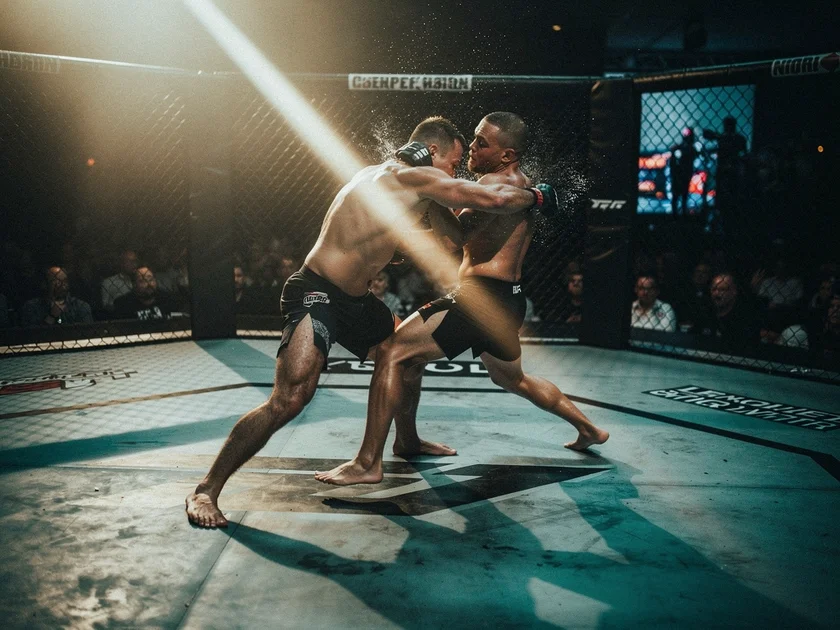
The UFC Featherweight Division enters April 2026 without a clean title contender narrative, rattled by a weekend that reshuffled MMA’s broader hierarchy. On Saturday, March 28, 2026, Joe Pyfer knocked out Israel Adesanya in the second round at UFC Seattle — the biggest win of Pyfer’s career — while RAF 7 delivered its own definitive verdict across town. Two events. Two finishes. One very complicated 145-pound picture.
At RAF 7, Arman Tsarukyan threw Georgio Poullas to win their rematch, closing out a rivalry that included a $10,000 side bet. Tsarukyan collected the money, then announced plans to donate it to a child in need. Personal grudge. Public resolution.
How Saturday’s Results Reshuffled the 145-Pound Picture
Pyfer’s second-round finish of Adesanya instantly made him must-see viewing. Historically, when the UFC lands a new star of that magnitude, booking attention and pay-per-view real estate shift fast — often at the expense of featherweight matchups already queued for the same quarter.
The UFC Featherweight Division has seen this pattern before. A marquee result in a neighboring weight class compresses the 145-pound timeline. Promoters expedite or delay title bouts based on broadcast strategy, not divisional merit alone. With Pyfer now the hottest name in the middleweight ranks, featherweight scheduling faces real uncertainty heading into Q2 2026.
Adesanya’s loss hit the locker room hard. Fellow fighters reportedly felt “flat” after the result, per MMA Fighting — a reaction that speaks to the former champion’s standing as a roster-wide figure whose outcomes affect morale beyond his own weight class.
Alexa Grasso’s finish on the UFC Seattle card added another layer. Grasso delivered what MMA Fighting described as a “nasty finish,” reinforcing her value as a reliable co-feature draw. Promoters weigh star power across genders and weight classes when building pay-per-view lineups. Grasso’s performance gives matchmakers another proven headliner — and that affects how the men’s featherweight bracket gets packaged alongside marquee names.
Tsarukyan at RAF 7 — What the Win Reveals
Arman Tsarukyan’s grappling-based victory over Poullas at RAF 7 showed sharp off-balance timing. The throw that ended the fight was technically clean — the kind of technique that travels across weight classes. Tsarukyan has built his game on pressure wrestling and clinch control, and this rematch confirmed both tools remain effective.
After the win, Tsarukyan called out Colby Covington, labeling him a “bullsh*t guy” in pointed post-fight remarks. The callout matters less as a likely booking and more as a positioning move. Crossover ambition is exactly what UFC matchmaking brass rewards with high-profile assignments, and Tsarukyan is clearly angling for one.
Tsarukyan’s entry timing against Poullas showed measurable improvement from their first meeting. He converted scrambles into dominant positions rather than relying on raw strength alone. That kind of technical growth separates contenders from champions — and his name stays firmly in the mix heading into summer 2026.
Precedent exists for the UFC to book fighters coming off high-profile wins outside the octagon into marquee assignments quickly. If the organization pulls that trigger, Tsarukyan could land a meaningful fight before July.
Key Developments From UFC Seattle and RAF 7
- Pyfer’s KO of Adesanya came at the 2:47 mark of Round 2, per UFC broadcast timing — the fastest finish of Adesanya’s career as a professional.
- The $10,000 side bet between Tsarukyan and Poullas was publicly negotiated before RAF 7, with Tsarukyan confirming the donation plan in his post-fight interview.
- Tsarukyan’s callout of Covington drew immediate social media traction, with the clip circulating widely within hours of the RAF 7 broadcast.
- Grasso’s finish at UFC Seattle extended her finishing streak to back-to-back UFC appearances, per MMA Fighting’s post-event recap.
- UFC Seattle drew a sellout crowd at Climate Pledge Arena in Seattle, Washington, giving the promotion a strong regional gate heading into the spring pay-per-view stretch.
Where the UFC Featherweight Division Stands Now
The UFC Featherweight Division carries genuine depth — historically one of the promotion’s strongest weight classes by roster talent. That depth is an asset when the organization needs a reliable card anchor without a single dominant storyline driving ticket sales. But depth alone does not manufacture a title narrative, and right now the 145-pound bracket lacks one.
Top-five featherweights who have been waiting on opponents or broadcast slots may find their timelines shifting further as UFC brass redirects pay-per-view positioning toward Pyfer and the middleweight story. An alternative reading holds that the featherweight division‘s reliability as a draw makes it easier to slot onto any card — no manufactured drama required. Both interpretations have merit. The next round of UFC scheduling announcements will clarify which direction the promotion intends to pursue.
Tsarukyan’s crossover callout of Covington raises a separate question. Will the UFC entertain cross-divisional matchmaking to capitalize on his RAF 7 momentum? That path could fast-track him toward a high-profile summer assignment — and pull even more booking attention away from the 145-pound bracket in the process.
Who is the current UFC Featherweight champion in 2026?
As of March 2026, the UFC Featherweight Division title picture lacks a confirmed next challenger. The weekend’s UFC Seattle card did not directly involve the 145-pound belt. Alexander Volkanovski held the title through much of the mid-2020s before Ilia Topuria claimed it in February 2024, with the championship lineage continuing into 2026 from that point.
What happened between Arman Tsarukyan and Georgio Poullas at RAF 7?
Tsarukyan defeated Poullas via a throwing technique in their rematch at RAF 7, settling both their rivalry and a publicly negotiated $10,000 side bet. Tsarukyan collected the funds after the fight and announced he would donate the full amount to a child in need, per MMA Fighting. The two fighters had genuine animosity heading into the rematch.
How did Joe Pyfer beat Israel Adesanya at UFC Seattle?
Pyfer knocked out Adesanya in the second round on March 28, 2026, at Climate Pledge Arena in Seattle. The finish came at the 2:47 mark of Round 2 and represented the most significant victory of Pyfer’s MMA career. Fellow fighters reportedly reacted with a sense of flatness to the result, per MMA Fighting, reflecting Adesanya’s stature across the roster.
Who did Arman Tsarukyan call out after RAF 7?
Tsarukyan called out welterweight contender Colby Covington in his post-fight remarks, referring to him as a “bullsh*t guy”. Covington, a former interim UFC welterweight champion, has long been a polarizing figure whose name generates attention. Tsarukyan’s callout circulated widely on social media within hours of the RAF 7 broadcast.
What did Alexa Grasso do at UFC Seattle?
Grasso recorded a finish at UFC Seattle on March 28, 2026, with MMA Fighting describing it as a “nasty finish”. A former UFC strawweight champion from Guadalajara, Mexico, Grasso has accumulated back-to-back finishing performances across her last two UFC appearances, per post-event reporting. Her output strengthens the case for women’s bouts as reliable pay-per-view co-features.