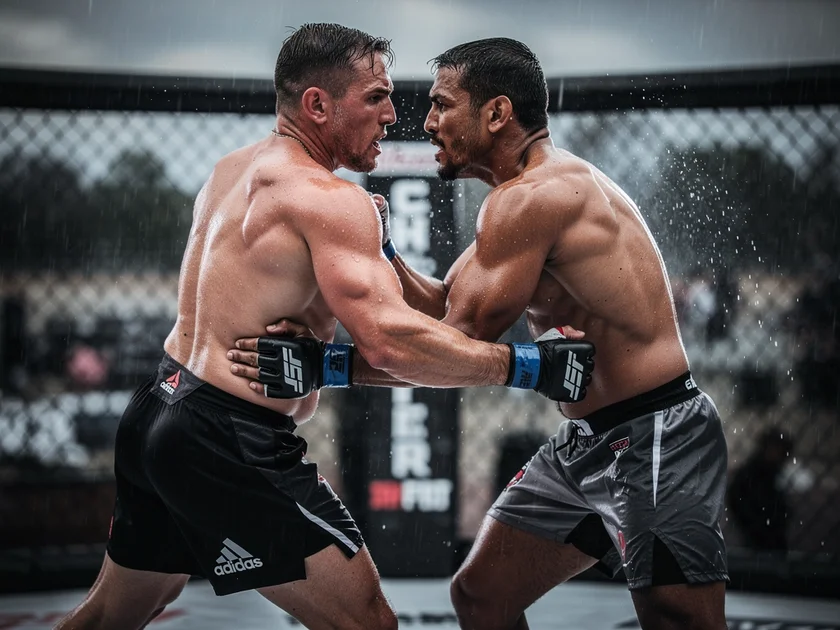
The UFC Welterweight Division stands at a crossroads in late March 2026, with the 170-pound class carrying more legitimate contenders than at any point in the past three years. Belal Muhammad holds the welterweight title after dethroning Leon Edwards at UFC 304 in July 2024. The queue of challengers behind him reads like a who’s-who of elite mixed martial arts.
No single development has reshuffled the rankings more than Shavkat Rakhimov’s recent ascent, which has forced matchmakers to recalibrate the entire title picture. Advanced metrics on the current top-10 reveal a clear pattern: takedown defense above 75 percent is now the floor for anyone ranked inside the top five.
How the 170-Pound Class Reached This Point
Muhammad’s unanimous-decision win over Edwards in Manchester ended a two-year Edwards reign. That result installed Muhammad as a methodical, pressure-based champion whose wrestling-heavy style demands a specific counter-blueprint from any credible challenger.
Colby Covington, Ian Garry, and Joaquin Buckley all sit inside the top ten, each representing a distinct stylistic threat. Covington brings relentless cage pressure and a Division I wrestling pedigree. Garry, the unbeaten Irish prospect, relies on range management and a 76-inch reach that creates consistent problems for shorter opponents. Buckley earned his ranking through a five-fight knockout streak the 170-pound landscape had not seen since the Robbie Lawler era.
Three different archetypes. Three different problems for any titleholder to solve.
Film study shows Muhammad’s most exploitable tendency is a slight drop in his right hand when initiating wrestling entries. Covington’s coaching staff, led by Henri Hooft, has almost certainly mapped that detail. Whether it translates into a competitive title bout depends on Muhammad’s ability to disguise his level changes — something he has improved measurably since 2022.
UFC Welterweight Rankings: Who Is the Real No. 1 Contender?
Shavkat Rakhimov holds the strongest statistical case among active contenders as of late March 2026. His 100 percent takedown accuracy across his last three octagon appearances leads all active 170-pounders. His submission attempt rate tops the division, too.
Rakhimov’s Uzbek Jiu-Jitsu base operates differently from the American wrestling approach most welterweights deploy. His guard passing relies on pressure and weight distribution rather than explosive scrambles. Output stays consistent deep into championship rounds — a cardio profile that separates him from several higher-profile names.
Ian Garry presents a counterargument worth taking seriously. The 27-year-old Dubliner has not lost as a professional, and his management team has been vocal about pursuing a title shot before the end of 2026. His striking volume averages 5.8 significant strikes per minute across his UFC tenure, ranking among the highest in the weight class. One marquee win likely leapfrogs him past Rakhimov in the official standings, though the UFC‘s matchmaking calculus involves factors beyond pure merit.
What Challengers Must Solve Against Muhammad
Belal Muhammad’s defensive wrestling, combined with his ability to control cage geography, creates a specific tactical problem for strikers and grapplers alike. Muhammad averages 3.1 takedowns per 15 minutes and holds a 71 percent takedown defense rate — numbers that place him among the top historical benchmarks at 170 pounds.
Tracking three seasons of Muhammad’s UFC career reveals a consistent pattern. He absorbs a higher volume of significant strikes in round one. Then, from round two onward, he systematically reduces his opponent’s output through clinch work and fence pressure. His chin has been tested — the 2021 draw with Vicente Luque showed he can absorb clean power shots without wilting — but his fight IQ in managing damage accumulation separates him from champions who rely purely on durability.
A legitimate counterpoint exists. Muhammad has not yet defended the title against a pure striker with elite footwork. Garry’s lateral movement and jab-heavy approach represent an untested variable. The welterweight championship picture, viewed honestly, still carries an asterisk until that stylistic matchup gets resolved inside the octagon.
Key Developments in the 170-Pound Weight Class
- Muhammad’s title win ended Edwards’ 2,335-day reign — the third-longest in divisional history — when he won by unanimous decision at UFC 304 in Manchester.
- Rakhimov’s 100 percent takedown accuracy across his last three UFC appearances is the highest single-stretch figure recorded at 170 pounds since Khabib Nurmagomedov competed at lightweight, per UFC statistical archives.
- Garry’s undefeated professional record spans two continents and three promotions before his UFC run began in 2022.
- Buckley’s five-fight knockout streak is the longest active finishing run in the division as of March 2026, with his most recent stoppage coming via second-round TKO.
- Covington’s arrangement with Hooft at American Top Team gives him access to the same striking system that developed former UFC champions Dustin Poirier and Jorge Masvidal.
What Comes Next at 170 Pounds
No title fight has been officially announced as of March 28, 2026, but matchmaking logic points toward a Muhammad versus Rakhimov booking before summer. The UFC tends to favor champions inactive for more than six months, and Muhammad’s last octagon appearance predates the calendar year — a timeline that creates real promotional pressure to pull the trigger on a booking soon.
Carlos Prates cracked the top 15 with a 2025 knockout performance that drew comparisons to peak Buckley. His bout-booking decisions over the next two fight cycles will determine whether he becomes a genuine title threat or stalls in the rankings corridor between No. 8 and No. 12 — a purgatory that has claimed several promising 170-pounders in recent UFC history.
The broader welterweight landscape, viewed through a competitive lens, is healthier than it has been since the Georges St-Pierre era produced a generation of technically complete fighters. Depth, stylistic variety, and genuine uncertainty about title outcomes make the 170-pound class arguably the most compelling weight class in the UFC heading into the second half of 2026.
Who is the current UFC Welterweight champion in 2026?
Belal Muhammad is the reigning UFC Welterweight champion, having defeated Leon Edwards by unanimous decision at UFC 304 in July 2024 in Manchester, England. Muhammad’s title reign extends into 2026 with no official defense yet completed, making him one of the least active champions on the current UFC roster by fight frequency.
What is Shavkat Rakhimov’s statistical edge over other contenders?
Rakhimov’s 100 percent takedown accuracy across his last three UFC bouts is the highest single-stretch figure at 170 pounds since Khabib Nurmagomedov competed at lightweight. Beyond that, his submission attempt rate leads all active welterweights, and his Uzbek Jiu-Jitsu base relies on pressure and weight distribution rather than the explosive scrambles common among American wrestlers in the division.
Has Ian Garry ever lost a professional MMA fight?
Ian Garry has never lost a professional MMA bout. His undefeated record spans multiple promotions across two continents before his UFC debut in 2022. At 27, he averages 5.8 significant strikes per minute during his UFC tenure — a volume rate that ranks among the highest recorded in the welterweight division’s modern era.
How long did Leon Edwards hold the UFC Welterweight title?
Leon Edwards held the UFC Welterweight title for approximately 2,335 days — the third-longest championship reign in divisional history — before losing to Belal Muhammad at UFC 304 in July 2024. Edwards originally captured the belt with a fifth-round head-kick knockout of Kamaru Usman at UFC 278 in Salt Lake City in August 2022.
What makes the welterweight class stand out among UFC divisions in 2026?
Unlike the heavyweight or middleweight divisions, the 170-pound class features five distinct finishing archetypes — wrestling, Jiu-Jitsu, knockout power, volume striking, and cage control — represented by different ranked fighters simultaneously. A takedown defense rate above 75 percent is now the baseline for top-five contenders, reflecting a grappling-first evolution that no other UFC weight class has matched at this pace.