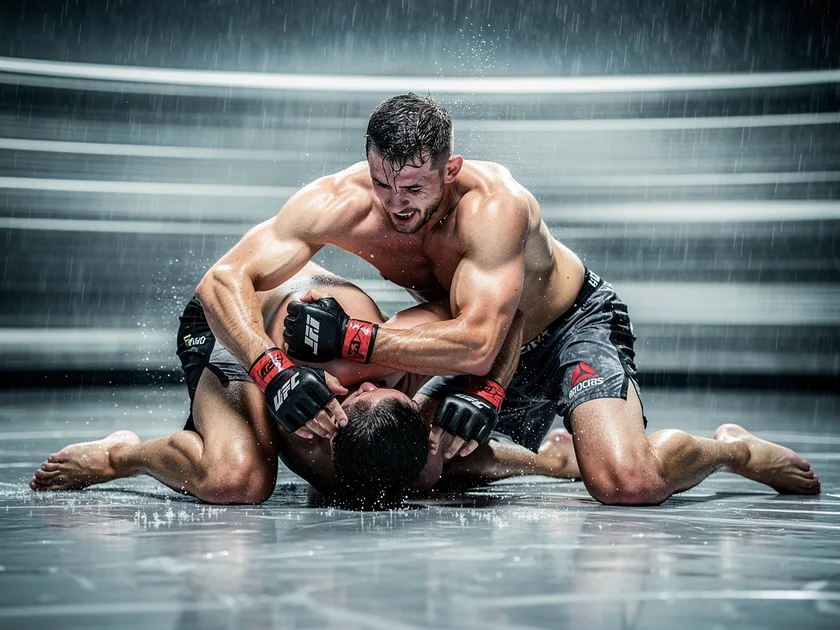
Islam Makhachev stands as the most technically complete fighter in the UFC lightweight division, holding the 155-pound title with a stranglehold that rivals any champion in the promotion’s history. The Dagestani grappler, trained under the legendary AKA and Abdulmanap Makhachev system alongside mentor Khabib Nurmagomedov, has redefined what dominance looks like at lightweight — blending elite sambo-based wrestling with sharp, measured striking that few opponents have found an answer to.
As of March 2026, Makhachev’s reign atop the UFC lightweight rankings reflects a near-flawless competitive record built on suffocating ground control, elite takedown defense, and a submission game that forces opponents into impossible positions. Breaking down the advanced metrics, his ground control time per fight and submission attempt rate place him among the most dangerous grapplers the UFC has ever produced at 155 pounds.
Islam Makhachev’s Path to Lightweight Supremacy
Islam Makhachev’s ascent to the top of the UFC lightweight division was not a sudden explosion — it was a methodical, years-long construction. After early career losses that exposed raw edges, Makhachev rebuilt his game into one of the most complete packages in MMA, winning 13 consecutive bouts before claiming the lightweight belt. That run included victories over former champions and top-five contenders, each fight adding a layer to his already deep technical arsenal.
The numbers reveal a pattern that separates Makhachev from his peers: his opponents rarely threaten him on the feet for long before being dragged into the grappling exchanges where he thrives. His striking, once considered a secondary weapon, has sharpened considerably — he uses jabs and level changes in combination, creating genuine two-dimensional danger that forces opponents to defend both planes simultaneously. That dual threat is what makes him so difficult to prepare for in a short training camp.
Khabib Nurmagomedov’s influence on Makhachev’s development cannot be overstated. The undefeated former champion has served as both coach and strategic architect, and the parallels in their styles — pressure wrestling, body-lock takedowns, top-position control — are unmistakable. Where Khabib relied heavily on pure physical dominance, Makhachev has added more technical variety, particularly in submission transitions from top position.
What Makes Makhachev Nearly Impossible to Beat?
Islam Makhachev‘s fight IQ is the single most underrated element of his game. He reads opponents’ weight distribution before initiating takedowns, times his level changes off his own jab, and almost never overcommits — a discipline that prevents the scrambles and reversals that have undone other elite wrestlers. His cardio holds through five rounds without visible degradation, which matters enormously in championship fights where the margin for error narrows late.
Looking at the tape from his title defenses, a clear structural pattern emerges: Makhachev pressures early to establish octagon control, then begins mixing his takedown entries around the 90-second mark of round one. By round two, most opponents are already reacting defensively rather than executing their own game plans. That psychological shift — from attacker to defender — is where his fights are effectively decided, even when the scorecards stay close on paper.
His submission game deserves specific attention. Makhachev has finished opponents with arm bars, rear-naked chokes, and body triangle setups, demonstrating versatility that goes well beyond a single go-to finish. His ability to transition between submission attempts while maintaining positional control gives him multiple paths to a stoppage from any dominant position — a trait shared by only the most elite submission grapplers in UFC history.
One counterargument worth acknowledging: Makhachev has faced questions about the depth of his opposition at the highest level. Based on available data, the lightweight division’s top tier has thinned somewhat, and a defining superfight — whether a rematch with Alexander Volkanovski at a natural weight or a high-profile matchup against a fresh contender — would sharpen the historical narrative around his reign considerably.
The Lightweight Division Landscape Around Makhachev
The UFC lightweight rankings in 2026 present a mix of established contenders and surging newcomers, all operating in Makhachev’s shadow. Charles Oliveira, the Brazilian submission specialist who lost the belt on the scales before Makhachev claimed it, remains a credible threat given his finishing ability — 21 UFC finishes make him the most dangerous grappler Makhachev could face stylistically. Dustin Poirier’s career arc has wound down, leaving a gap among proven American contenders.
Justin Gaethje, the former interim champion whose forward pressure and leg kick volume create genuine problems for wrestlers, represents another compelling matchup. Gaethje’s willingness to absorb punishment to land his own shots cuts against Makhachev’s preferred rhythm of controlling distance and timing entries. Whether Gaethje’s chin and power shots can disrupt Makhachev’s composure long enough to change a fight’s trajectory is the central tactical question a rematch would answer.
Arman Tsarukyan, Makhachev’s former training partner who pushed him to a decision in their first meeting, has developed into a legitimate title contender and represents perhaps the most stylistically awkward challenge available. Tsarukyan’s own wrestling base and relentless pace mirror enough of Makhachev’s attributes to suggest a rematch would be genuinely competitive — a rarity at this level of the division.
Key Developments in the Makhachev Era
- Makhachev claimed the UFC lightweight title at UFC 280 in October 2022, submitting Charles Oliveira in the second round with an arm bar — his first world championship after years as a consensus top contender.
- His two-division experiment saw him challenge Alexander Volkanovski for the featherweight title at UFC 284, winning a close unanimous decision that Volkanovski immediately disputed, setting up a rematch narrative that ran through 2023.
- Arman Tsarukyan, who lost to Makhachev by decision in April 2019 — before either fighter reached elite status — has since become the most credible in-division challenger, with the rematch framing built on four years of parallel development.
- Makhachev’s AKA training camp connection links him directly to the broader Dagestani MMA pipeline, which has produced multiple UFC champions and contenders across weight classes simultaneously.
- The UFC’s lightweight title picture has been complicated by weight-cut politics, with several top contenders competing at 155 while managing the physical toll of cuts from natural weights closer to 170 — a factor that affects preparation quality and fight-night performance.
What Comes Next for Islam Makhachev and the 155-Pound Belt?
Islam Makhachev‘s next title defense will carry significant weight in shaping his legacy argument. The numbers suggest his peak years are still ahead — most elite grapplers in MMA reach their technical ceiling in their early-to-mid 30s, and Makhachev’s style, built on timing and positional discipline rather than explosive athleticism alone, ages well. A dominant run through 2026 and 2027 would place him firmly in the conversation for the greatest lightweight of all time, a discussion currently anchored by Khabib’s perfect record and Frankie Edgar’s longevity.
The Tsarukyan rematch, if booked, would be the division’s most anticipated event in years. Beyond that, a potential superfight with a welterweight champion — a cross-divisional challenge that Dana White has floated publicly in the past — would test Makhachev’s frame and reach advantage against a naturally larger opponent. Based on available data from his featherweight title challenge, Makhachev’s wrestling transfers across weight classes without meaningful degradation, which makes those conversations more than promotional fantasy.