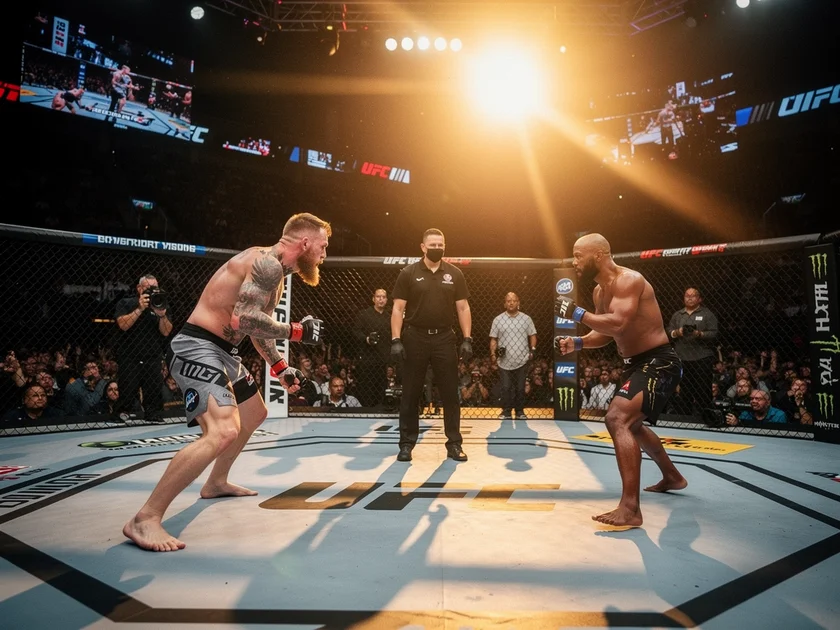
Conor McGregor, the former UFC dual-weight champion whose last octagon appearance came in June 2021, remains the most commercially dominant figure in MMA despite an absence now stretching nearly five years. No formal return date has been confirmed as of March 29, 2026, leaving the lightweight and welterweight divisions in a state of structured uncertainty around his potential re-entry. The UFC’s current landscape has shifted considerably since McGregor last competed, making any comeback a complex sporting and promotional puzzle.
Meanwhile, the lightweight division — McGregor’s most celebrated weight class — just produced a defining title fight at UFC 313, where Islam Makhachev defeated Arman Tsarukyan by decision to retain the 155-pound championship. That result, and the division’s current depth, frames exactly what McGregor would be walking back into.
Where the Lightweight Division Stands After UFC 313
Islam Makhachev’s decision victory over Arman Tsarukyan at UFC 313 reinforced the Dagestani champion’s grip on the lightweight title, a belt McGregor last challenged — indirectly, through his 2016 title capture — a decade ago. Makhachev’s win was described by former champion Justin Gaethje’s camp and divisional observers as proof the champion remains beatable on paper but functionally dominant in execution. The gap between McGregor’s last active ranking and the current top five is not merely stylistic — it is structural.
Tsarukyan, who pushed Makhachev harder than most contenders have managed, now faces a recalibration of his title timeline. The division’s contender pool — featuring names like Charles Oliveira, Dustin Poirier in a reduced capacity, and rising ranked fighters — is considerably more technically refined than the 155-pound landscape McGregor navigated during his peak run between 2015 and 2016.
Breaking down the advanced metrics from UFC 313, Makhachev’s ground control time and takedown efficiency against Tsarukyan underscored why any returning fighter — McGregor included — would need a credible grappling answer before earning a title shot. McGregor’s historically weak takedown defense, a documented vulnerability exploited by Khabib Nurmagomedov in their 2018 bout, would be the first technical question any serious contender camp would raise.
Conor McGregor’s Comeback Timeline: What We Know
Conor McGregor’s return has been anticipated, delayed, and re-anticipated across multiple calendar years. Based on available data from UFC promotional activity and public statements through early 2026, no sanctioned fight contract has been publicly executed. McGregor’s USADA testing pool status — a mandatory requirement for UFC competition — has been a recurring procedural question, given that fighters must complete a re-entry testing period before being cleared to compete.
The UFC’s anti-doping partnership requires fighters outside the testing pool to complete a minimum re-entry window before octagon clearance. McGregor’s legal proceedings in Ireland, connected to civil litigation that concluded in late 2024, added further scheduling complications to any fight timeline the promotion might have been constructing. UFC President Dana White has repeatedly expressed interest in booking McGregor, but the promotional machinery requires medical clearance, USADA compliance, and a viable opponent — three variables that have not aligned simultaneously.
From a pure fight-IQ standpoint, the McGregor who beat Eddie Alvarez at UFC 205 in November 2016 — landing precise left hands off a tight, low-stance — was operating at the peak of his technical output. The numbers suggest that a five-year competitive layoff, combined with the leg injury suffered against Dustin Poirier at UFC 264 in July 2021, presents a genuine athletic reclamation project, not simply a matter of motivation.
Which Weight Class Makes Sense for a McGregor Return?
Conor McGregor’s most logical re-entry point is welterweight at 170 pounds, not lightweight. His frame has filled out considerably since his 155-pound title run, and the physical demands of a hard weight cut back to lightweight — at age 37 — introduce cardiovascular and recovery variables that could compromise his performance ceiling before the first bell rings.
Welterweight presents a different set of matchmaking options. Fighters like Michael Chiesa, who is ending his UFC career at fight No. 22 according to ESPN reporting, represent the veteran tier of the division — but McGregor’s return would target a higher-profile opponent for maximum commercial yield. A fight against Nate Diaz, should Diaz return to the UFC from his boxing ventures, or a rematch with Poirier at 170 pounds, would generate pay-per-view numbers that rival any non-heavyweight title fight the promotion could construct.
The counterargument — and it deserves serious weight — is that McGregor’s brand equity demands a title-adjacent narrative. A welterweight fight without a clear path to the belt risks being framed as an exhibition rather than a genuine comeback, which could undercut the promotional value the UFC is banking on. That tension between commercial positioning and sporting credibility is the central negotiation the promotion faces.
Key Developments in the McGregor Comeback Picture
- Islam Makhachev retained the UFC lightweight title at UFC 313 with a decision over Arman Tsarukyan, deepening the competitive barrier McGregor would face at 155 pounds.
- Michael Chiesa is retiring after UFC fight No. 22, a milestone ESPN described as “serendipitous” for the veteran welterweight, further thinning the mid-tier contender pool at 170 pounds.
- The UFC’s featherweight division saw Movsar Evloev edge Lerone Murphy and return near the top of the rankings — Murphy, who headlined UFC London, was previously noted for escaping a near-death experience before his rise.
- Flyweight legend Demetrious Johnson is set to enter the UFC Hall of Fame, a ceremonial marker that underscores how much the promotion’s legacy class has shifted since McGregor’s peak era.
- The U.S. House advanced a boxing-reform act with unresolved questions still attached, a legislative development that MMA promoters, including the UFC, are monitoring for potential regulatory spillover.
What a McGregor Return Would Mean for the UFC in 2026
Conor McGregor’s commercial pull on UFC pay-per-view numbers is empirically documented. His three fights against Nate Diaz and the Khabib Nurmagomedov bout at UFC 229 collectively generated over 4 million pay-per-view buys combined, figures that no active fighter on the current roster has matched on a per-event basis. A 2026 return, even at welterweight and outside the title picture, would almost certainly produce the promotion’s highest-grossing event of the calendar year.
The film shows, however, that McGregor’s last two performances — both losses to Poirier at UFC 257 and UFC 264 — revealed deterioration in his leg kick defense and a reduced output in the later rounds of UFC 257. His chin, always a topic of technical debate among hardcore fans, absorbed clean shots from Poirier that earlier opponents could not land. Any credible return narrative has to account for those tape-verified patterns, not paper over them with promotional language.
UFC matchmakers and the broader fight community will watch the second half of 2026 for any formal announcement. The promotional infrastructure is ready; the sporting variables are not yet resolved. Whether McGregor can deliver a performance that matches the commercial expectation is the defining question his 2026 arc must answer.
When did Conor McGregor last fight in the UFC?
Conor McGregor last competed at UFC 264 on July 10, 2021, against Dustin Poirier in Las Vegas. The fight ended in the first round when McGregor suffered a broken tibia, resulting in a TKO loss. That injury has been central to the prolonged timeline of his attempted comeback.
Does Conor McGregor need to re-enter the USADA testing pool before fighting?
Under the UFC’s anti-doping program, fighters who have been outside the registered testing pool must complete a mandatory re-entry period before receiving clearance to compete. The specific duration can vary based on the length of absence and the fighter’s testing history. McGregor’s compliance status has not been publicly confirmed as of March 2026.
Who is the current UFC lightweight champion heading into a potential McGregor return?
Islam Makhachev is the reigning UFC lightweight champion after defeating Arman Tsarukyan by decision at UFC 313 on March 29, 2026. Makhachev, trained by the AKA and Abdulmanap Nurmagomedov’s lineage through Khabib, has defended the title multiple times and is widely regarded as the most complete fighter in the 155-pound division.
What is Conor McGregor’s professional MMA record?
Conor McGregor holds a professional MMA record of 22 wins and 6 losses. His victories include notable finishes over Jose Aldo — a 13-second knockout that set a UFC title fight record — Eddie Alvarez, and Marcus Brimage. His six losses came against Nate Diaz, Khabib Nurmagomedov, and Dustin Poirier twice.
Could Conor McGregor realistically challenge for a UFC title in 2026?
Based on available data, a direct title shot in 2026 is unlikely without at least one tune-up fight to re-establish octagon credentials and ranking position. UFC title shots at lightweight require navigating Makhachev’s elite grappling and ground control — attributes that exposed McGregor’s defensive gaps in the Nurmagomedov fight at UFC 229 in October 2018.