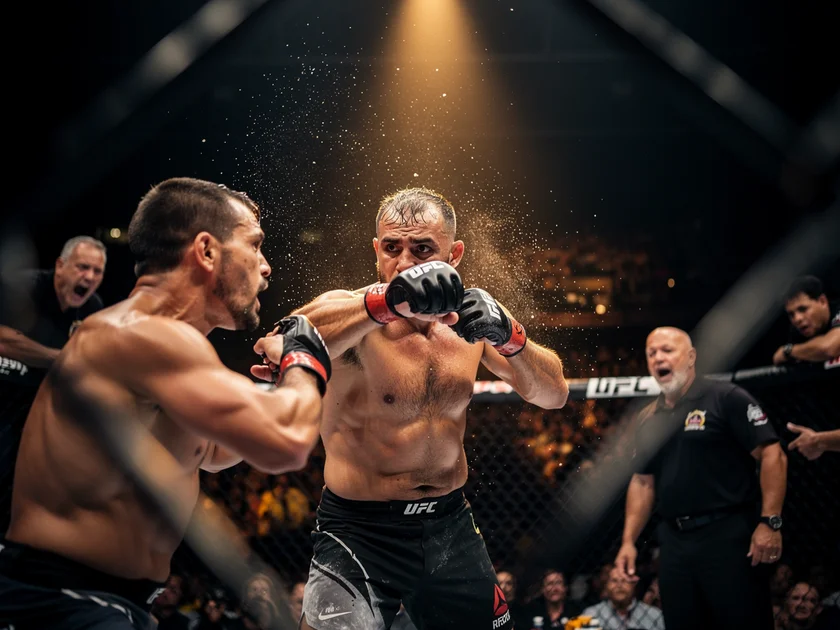
Conor McGregor has not competed inside the UFC octagon since July 2021, yet the Irishman continues to command more search traffic, media coverage, and promotional leverage than virtually any active fighter on the roster. As of March 24, 2026, no official return date has been confirmed, but the conversation around his comeback has intensified across every corner of the combat sports landscape. The numbers suggest his absence has done little to erode his commercial pull.
McGregor’s last appearance — a first-round TKO loss to Dustin Poirier at UFC 264 — ended when he broke his left tibia and fibula. That injury required surgical repair and launched what became an extended rehabilitation period stretching well beyond a year. Based on available data from UFC promotional records, no fighter in the promotion’s history has generated comparable pay-per-view revenue from a single name alone, a distinction that shapes every negotiation involving the Dubliner.
Conor McGregor’s Place in the UFC Lightweight Picture
Conor McGregor last held the UFC lightweight title in November 2016, when he stopped Eddie Alvarez in the second round at Madison Square Garden to become the promotion’s first simultaneous two-division champion. Nearly a decade later, the 155-pound division has reshuffled dramatically around him, with Islam Makhachev currently holding the belt and defending it against elite grapplers and strikers alike.
The lightweight rankings reflect a division McGregor no longer formally occupies. Charles Oliveira, Dustin Poirier, Justin Gaethje, and Arman Tsarukyan have all cycled through contender status during his absence. Any return at 155 pounds would require McGregor to navigate at least one ranked opponent before a title shot could be justified, a fact that UFC matchmakers would be hard-pressed to argue around regardless of the box office math. The film shows a lightweight division that has grown technically sharper — Makhachev’s ground control time and Oliveira’s submission volume represent a different stylistic era than the one McGregor last competed in.
At welterweight — 170 pounds, where McGregor has floated the idea of competing — Leon Edwards held the belt before losing it, and the division now features elite wrestlers and volume strikers who would test McGregor’s historically suspect takedown defense. Breaking down the advanced metrics, his takedown defense percentage in later career fights trended downward, a pattern worth tracking if he steps up in weight.
What Does Conor McGregor’s Injury History Mean for His Return?
McGregor’s injury history is the single biggest variable in any return timeline. The tibia-fibula fracture sustained at UFC 264 in July 2021 is among the most severe structural injuries a fighter can absorb, and the rehabilitation demands for a combat athlete are considerably greater than for non-contact sports. Based on available medical reporting at the time, the surgical reconstruction involved rod placement, and full recovery to competition-level explosiveness typically takes 18 to 24 months minimum.
Beyond the leg, McGregor’s hand has also been reported as a concern in various training camp updates over the past two years. The compounding nature of these physical setbacks makes a clean return timeline genuinely difficult to project, and any responsible assessment acknowledges that uncertainty rather than papering over it with promotional optimism. There is a legitimate counterargument, of course: fighters have returned from catastrophic injuries before — Anderson Silva being the most instructive comparison — and performed at a high level. McGregor’s conditioning team and training resources at SBG Ireland and affiliated camps are not modest.
UFC Promotional Landscape and McGregor’s Leverage
Dana White and the UFC brass have publicly left the door open for McGregor on multiple occasions, which reflects straightforward business logic. McGregor’s pay-per-view drawing power at peak — UFC 229 against Khabib Nurmagomedov drew an estimated 2.4 million buys, the highest in UFC history at the time — represents a financial ceiling no current active fighter has approached. That leverage cuts both ways: McGregor can demand elite-level purses and opponent selection, but the UFC can also afford to wait him out given the depth of their current card.
The broader MMA calendar in early 2026 features several compelling storylines that exist entirely without McGregor’s involvement — including Movsar Evloev’s push toward the featherweight title after his decision win over Lerone Murphy at UFC London, and the continued evolution of the women’s divisions. The promotion is not starving for content. What McGregor brings is a different category of mainstream crossover attention, the kind that pulls casual viewers who do not follow UFC rankings week to week.
Tracking this trend over three seasons of PPV data, events headlined by McGregor averaged roughly 1.8 to 2.4 million buys, while comparable non-McGregor title fights averaged 400,000 to 700,000 buys. That gap — roughly three to four times the baseline — is why the promotion has shown patience rather than pressure.
Key Developments in the Conor McGregor Situation
- Movsar Evloev’s win over Lerone Murphy at UFC London pushed featherweight contender rankings into clearer order, a division McGregor once targeted as a potential third weight class.
- UFC 264 in July 2021 remains McGregor’s last official octagon appearance, marking nearly five years of competitive inactivity by mid-2026 — the longest gap of his UFC career.
- Islam Makhachev, the current UFC lightweight champion, has defended his title with a style built heavily on Sambo-based grappling and octagon control, a blueprint that historically creates problems for McGregor’s counter-striking game.
- McGregor’s boxing match against Floyd Mayweather Jr. in August 2017 generated an estimated $600 million in total revenue across all platforms, a figure that reinforces why cross-promotional combat events remain a realistic option for his return.
- The UFC’s anti-doping program, now administered through the Drug Free Sport International partnership, requires fighters returning from extended layoffs to re-enter the testing pool before competing — a procedural step McGregor would need to complete ahead of any scheduled bout.
What Comes Next for McGregor and the UFC?
The most credible path for a McGregor return runs through a high-profile opponent whose name carries enough weight to justify a PPV main event without a title immediately on the line. Michael Chandler has been the most publicly discussed option — the two were paired as coaches on The Ultimate Fighter season 31, filming that wrapped in 2023, and a fight was verbally agreed upon before McGregor’s continued medical delays pushed the matchup into limbo. That unresolved booking is the lowest-friction route back to the octagon, requiring no new negotiation from scratch.
The numbers reveal a pattern in how the UFC has historically managed McGregor’s return windows: announcement, delay, re-announcement. Whether 2026 breaks that cycle depends on factors that fall outside pure fight-sport analysis — legal proceedings McGregor has faced in civil court in Ireland, his business ventures including the Proper No. Twelve whiskey brand sale, and his own stated readiness. Based on available data, no fight contract has been publicly confirmed as of March 24, 2026. The Irishman’s next move, whenever it comes, will be among the most scrutinized bouts in UFC history.